


On October 30th, members of U.S. Figure Skating (USFS) received an email from CEO Matt Farrell, announcing new rules to restrict the participation of transgender and nonbinary athletes in domestic figure skating competitions.
The email, titled “New Category Policy for U.S. Figure Skating Sanctioned Competitions”, began with a claim that the federation was proceeding from a longtime stance of supporting inclusion:
“At U.S. Figure Skating,” Farrrell wrote, “we have long embraced a spirit of inclusion, offering diverse programs that allow each of our members to find their place within our community. That commitment remains at the heart of everything we do, particularly as we navigate changes in policy to ensure that our sport continues to be welcoming and fair for all and ensuring U.S. Figure Skating continues to be one of the most inclusive sports.”
Then, Farrell finally revealed what the email was really about:
“Recently, the United States Olympic and Paralympic Committee (USOPC) determined that under the Ted Stevens Act and further under Executive Order 14201, all national governing bodies (NGBs) must adopt a policy that limits participation in the female category to athletes who were assigned female at birth. In light of this, U.S. Figure Skating is releasing a new category policy for sanctioned competitions requiring that athletes competing in the Female Category be listed as female at birth on their original birth certificate“ (Italics added).
Political Context
Farrell ended the email by re-emphasizing USFS commitment to inclusion: “We remain deeply committed to providing meaningful opportunities for every member to participate. This includes gender-neutral disciplines and programs such as synchronized skating, Theatre on Ice, showcase, solo dance and team maneuver events.”
However, the new policy effectively bars trans women and girls from competing in women’s singles events, or as the female member of a pairs or dance team.
This policy represents an exclusionary change in gender policy. Prior to this announcement, US Figure Skating allowed trans women to compete in women’s events in many circumstances. The Gender Policy approved by the USFS board in 2016 allowed participation in women’s category if a trans woman or girl either transitioned before puberty or maintained a testosterone level under 10nl. Admittedly, this policy was far from ideal. Relying, among other flaws, on legitimately contested scientific criteria, it was nonetheless broader and more inclusive than the new one. It also reflected the International Olympic Committee’s stance on transgender competitors in women’s sports, which is similar to the ISU’s policy.
The policy landscape changed, however, in February, when US President Donald Trump signed an executive order titled “Keeping Men Out of Women’s Sports.” On July 22, the US Olympic and Paralympic Committee sent a letter to NGBs, stating, “As a federally chartered organization, we have an obligation to comply with federal expectations […] Our revised policy emphasizes the importance of ensuring fair and safe competition environments for women. All National Governing Bodies are required to update their applicable policies in alignment.”
Many LGBTQ+ and women’s rights organizations have opposed the executive order and USOPC’s stance. Athlete Ally released a response, stating: “This policy change is another example of an institution giving up their authority and expertise to politicians who have no credibility dictating athlete safety. This rule change is not in response to new research or new guidelines from medical experts in sports. Instead, it is the result of mounting political pressure and government hostility toward one of the smallest minorities in society, let alone sports.”
The USFS announcement quickly sparked a wave of responses.
It came as a surprise to most, including USFS’ own Diversity, Equity and Inclusion (DEI) Task Force, which was not informed about the policy until the day of the email.
Members of the DEI Task Force are now taking a multi-pronged approach to addressing it. Elizabeth Mitchell and Erica Rand are leading a project to develop resources for trans and non-binary skaters. They explained: “These resources will also help USFS clubs, rink staff, other skating organizations, and others in the community pro-actively provide support for trans and nonbinary skaters. Interested people can sign up to receive resources, provide feedback, or get involved at skatingpartner.com.”
Transgender Figure Skaters React
It is impossible to know how many trans women compete in U.S. Figure Skating events currently, as the federation does not track this data. When joining USFS members must choose whether to register as male or female (no nonbinary option exists). For individuals who join USFS after transitioning, they simply sign up as female.
But many skaters are undoubtedly affected, and some have been speaking out about their opposition.
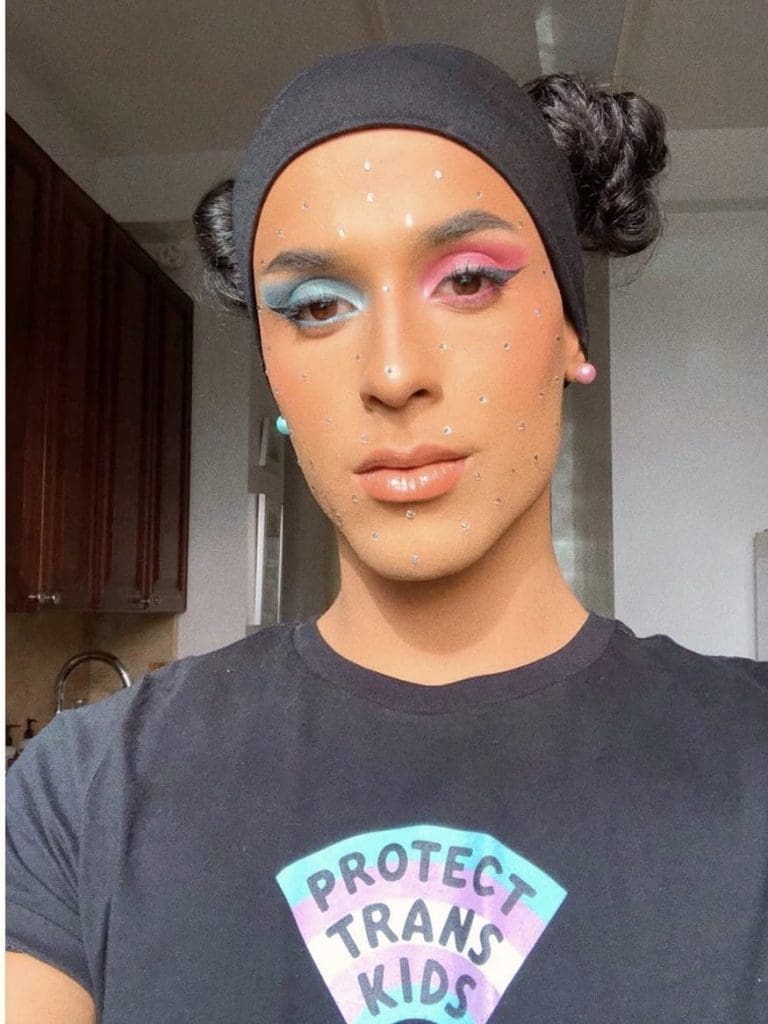
Eliot Halverson is a trans femme nonbinary coach and choreographer in New York City, and the 2007 Junior Men’s US champion. She posted a video on Instagram criticizing the USFS decision, and noting that the impacts will go beyond trans women.
“If anybody wants to question any young athlete’s gender, then what? We just start checking birth certificates now? This is dystopian, this is crazy, and it’s not going to just impact trans athletes. This is going to impact any woman, any girl, that somebody doesn’t deem to be up to this level of femininity.”
“It’s devastating beyond words,” Halverson continued, “ […] and I don’t really care that [USFS’] hands are tied and that there’s pressure that maybe we feel we can’t escape. I have said it for years, and I’ll say it again, figure skating, U.S. Figure Skating should be at the forefront, leading the charge for gay inclusion in sports, and trans inclusion in sports. And that U.S. Figure Skating […] is going to attack a minority group like this is mind-blowing. It’s so disappointing.”
“I am already getting texts from coaches around the U.S. who have trans athletes, adult skaters, adult trans women athletes, who compete in a week, asking, ‘Am I going to be put in a different group now? Is this going to impact my competition for next week?’ People are already scared. Already U.S. Figure Skating is creating an environment of fear and of hatred in our communities. The audacity of this email to be so focused on inclusion and how this is such a welcoming sport —absolutely not. This decision, this new policy, is rooted in exclusion, in discrimination, in bigotry and hatred, none of which is what US figure skating is actually about.”
Flora is an adult skater who lives in Tennessee. She began skating a year ago, and has competed in women’s singles events locally. Prior to the USFS announcement, she hoped to compete at the Adult Sectional and National championships in 2026. She and her coach are trying to figure out what she should do now.
While Flora also participates in Theater on Ice — one of the open-gender disciplines referenced in the US Figure Skating letter as trans-inclusive alternatives — she notes that it’s not a replacement for competing in singles.
“I imagine my reasons [for wanting to compete] are largely the same as any cis skater who competes in both singles and group events: for joy and love of the sport. [A singles program is] a precious ~100 seconds of ‘Look at me, this is what I’ve spent sweat, tears, and hours of my life on. Let me share it with you.’ Stepping onto any stage, land or ice, is a rare privilege and, in my opinion, an almost intimately vulnerable moment.”
“Skating in the men’s category would be to either hide myself, or to out myself as trans, as inherently different, as not a woman,” Flora shared. “I’d be skating as one of 3 or so men, while the dozen women competing at the same level look on. That kind of separation would be humiliating and heartbreaking.”
She also notes that the policy will likely affect cisgender skaters as well. “I’m quite sure that this will result in harassment of far more insufficiently-feminine cis women than it will ban the few dozen trans femme skaters competing nationwide. It’s honestly just like bathroom bans: policing womanhood.”

While Flora began skating after she transitioned, other skaters transition after a childhood spent competing in the sport.
Sara [name changed to protect identity] was assigned male at birth, and competed in men’s events as a child and teenager. Sara asked their sister to speak to AnythingGOEs on their behalf.
As Sara’s sister explained, the environment at the rink where Sara skated growing up was openly hostile to queer and trans people. When they transitioned, they stopped skating for a year and a half. This experience, Sara’s sister pointed out, challenges U.S. Figure Skating’s claim of inclusiveness throughout the sport, “One thing about the USFS announcement [is] they talked about how inclusive they were. [But] this was our experience in the last 5 years. When they started transitioning, they felt the need to not be at the rink for a year and a half. It says a lot.”
Sara later moved to a different state and a more welcoming rink, and began to compete as an adult skater. “There are a couple of adult figure skaters at that rink who are trans as well,” explained their sister. “So they have a nice support system there, which has been amazing. Skating has been the only place that they found friends, literally ever, in their entire life…the big thing that they do in their free time is skate and compete. And so now they won’t be able to. Now they are not sure what to do, because they have really been putting a lot of time and effort into their jumps. They want to compete in free skating, but they’re obviously not willing to compete in the men’s section because that’s humiliating and crazy.”
Sara and their sister think that a partial remedy could be to combine the gender categories in adult skating, where the women’s events tend to have more entrants, and often, stronger skaters, than the men’s. “We discussed this and think [a gender-neutral competition] makes sense…Also, for people who do want to compete in the men’s category, it would be a lot better because they would actually have competitors. And I know that’s a big frustration that my sibling faced growing up: they never, ever, got to compete with anybody, because there was never anybody [in the men’s events].”
While some trans women and girls are public about their trans status, many others are not.
In researching this story, AnythingGOEs learned about a teenage trans girl who competes in Excel, the recreational track within USFS. For skaters like this, who transition at a young age, it is likely that most people in their skating community assume that they are cisgender. Complying with the USFS policy would mean disclosing their trans status, potentially putting them at risk of harassment.
A nonbinary adult skater, Jordan [name changed to protect identity], wonders whether USFS truly intends to enforce the policy, particularly at the grassroots and adult level. “According to the wording, it was made effective, I believe, in August, and then revised in September, and then published […] within the past week. Trans women have been competing in that time. And nothing has happened. How are they going to enforce this? The gender is self-select in U.S. Figure Skating profiles. They ask for nothing, as far as I know, in terms of asking for verification or documentation or anything like that.”
Jordan also stressed that USFS’ decision feels like a small part of the broader attacks on trans people and other marginalized identities. “I see and I feel a lot of anger towards U.S. Figure Skating,” they said. “The real issue, though, is the USOPC. The real issue is our current government and people in positions of power within our government who are allowing, pushing, and celebrating fascism, bigotry, oppression. I don’t think that U.S. Figure Skating has the money to legally take on the USOPC. If anything, I appreciate finding the silver lining, where I can, of the open-ended language [in USFS’ letter] and the inclusion of open-gender disciplines to be like, because at least to me, it comes off as like, ‘we are doing what we have to to stay sanctioned as a sport in an Olympic year. Whether that’s right or wrong. So that we can still exist.’
Jordan would also support making the Adult and Excel competitions open-gender events. They emphasized that it is important for trans people, regardless of competitive status, to find ways to keep skating.
“I know people who are like, ‘I’m not redoing my U.S. Figure Skating membership, I am done with you, with figure skating under USFS,’ and, I don’t blame them. But I find myself in a position where I continue to get better at skating. This is where I see, and my coaches see, this unique opportunity of ‘existence is resistance’[…] It sucks that we have to keep showing up like this despite everything, but it’s also incredible to continue showing up despite everything. That’s also why I’m kind of like, if you’re able to, and you are a trans woman or you are trans femme: fucking do that competition. If you can handle it, emotionally, physically, it doesn’t put you at any threat to your safety, do the competition. Show up and do your skating. Regardless of what they are allowing or not allowing.”
Halverson ended her Instagram reel with a call to solidarity from allies. “When you hear people maybe applauding this decision […] what are you gonna say? Are you gonna stay silent? And I actually, unfortunately, think a lot of you will […] Who’s really going to go to bat for trans people in US figure skating? I hope that more of you will. And I think that unfortunately that’s the only solution we have here.”
“We have each other, and the resiliency of trans people is unmatched by anyone. And it sucks, and I hate that we have to be resilient. I hate that we have to be so strong. I am sick of being resilient. I am sick of being strong. So over it. But what the fuck else are we gonna do? So we will persist. We will keep going. We are being put in some dark corners here…but trans people, queer people supply light to this world, and supply light to skating. And so it doesn’t matter where you put us. Put us in the men’s category, shove us to the darkest corners and bop us on the head with the hatred stick. You can’t take away our light. It’s not gonna happen…I feel it’s important to say right now too, I love skating, and I believe in the power of figure skating and figure skaters so much more than I believe in U.S. Figure Skating, and way more than I believe in the power of hatred.”
Learn more about efforts to support trans skaters in the US at skatingpartner.com