



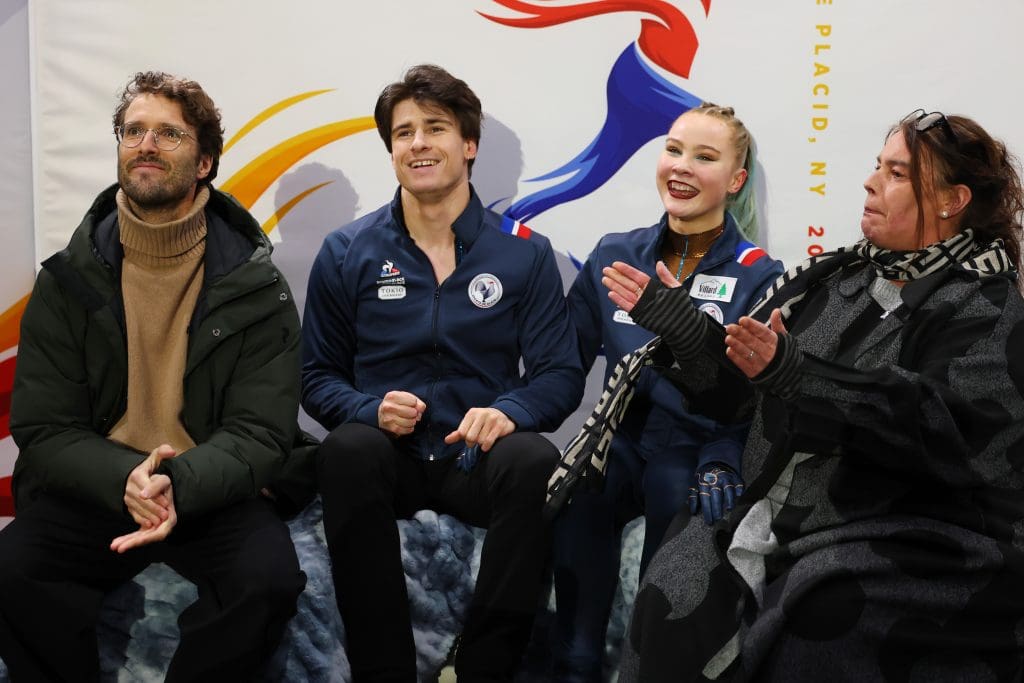
Coach Karine Arribert and her team at Villard de Lans are known for avant-garde and sometimes off-beat ice dance choreography. At Skate America 2025, Arribert accompanied two teams with very different goals for this Olympic season. She shared her thoughts on a range of topics, including the return of Guillaume Cizeron, the coach’s role in supporting skaters’ mental health, and the direction she’d like to see for ice dance in the future.
Grand Prix progress
Celina Fradji and Jean-Hans Fourneaux are making their senior debut this season. They finished tenth in the highly-competitive Grand Prix event.
“Celina and Jean-Hans come from the junior level,” Arribert explained, “so they have to learn, and they have to improve a lot in maturity. It’s a big difference in speed of skating and maturity, but they skated clean, both programs, so I’m pretty happy.”
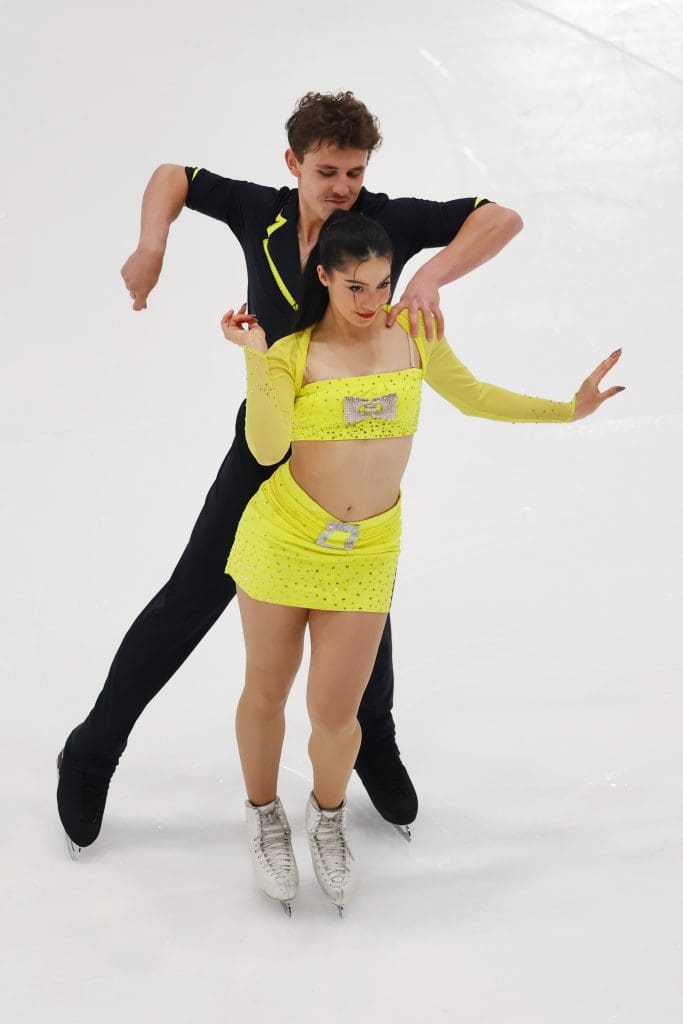
The points, however, were disappointingly lower than their first event, Grand Prix de France.
“The score was terrible for them. It was a difficult competition. The panel was really hard, but… [they were hard] with everybody, because it’s an Olympic year. So it’s okay, but it’s difficult for them. It’s a really low score, but they have to improve, they are 20 years old, they are young.”
At the senior level, what the judges look for changes, Arribert explained. “It’s about amplitude, big movement. Maturity is not dancing small. They have to find another energy level. In the junior level, they have to skate clean, to be together; senior level, it’s something different. Celina and Hans have a big personality, so there is no problem for them in the future. But you have to improve, to take up space on the ice rink. [Their skating is] too small. But I’m pretty sure they will be a good senior team in two or three years.”
Arribert’s other team at Skate America, Loïcia Demougeot and Théo Le Mercier, placed 4th, matching their best Grand Prix result. Arribert was pleased with the progress they made since their first event, the Cup of China.
“We worked a lot since China. I was so upset after the free dance, because they did a big mistake. It’s a really difficult free program, physically. They said, ‘It’s too hot. I’m not good, it’s so hard,’ but I said, ‘Okay, we needed to travel to China. You have to do your job, guys, [no matter the conditions].’ So, we came back, and I was really upset one week. We worked a lot, and I explained to them, if they want to be real athletes, they have to work more. And it was a really good week. So, I’m really happy, they had a really good rhythm dance and a really good free dance [at Skate America].”

Making it to the second group of skaters, and beating Christina Carreira and Anthony Ponomarenko, was a big achievement for them. “When they were young, they saw Ponomarenko win silver at Junior Worlds,” Arribert explained. At that competition, in 2018, Loïcia and Théo placed 15th. “They have improved a lot, and in the last year, they [especially] improved a lot. They changed the group of skaters, and now they are [among] the best ones, so it’s a big deal.”
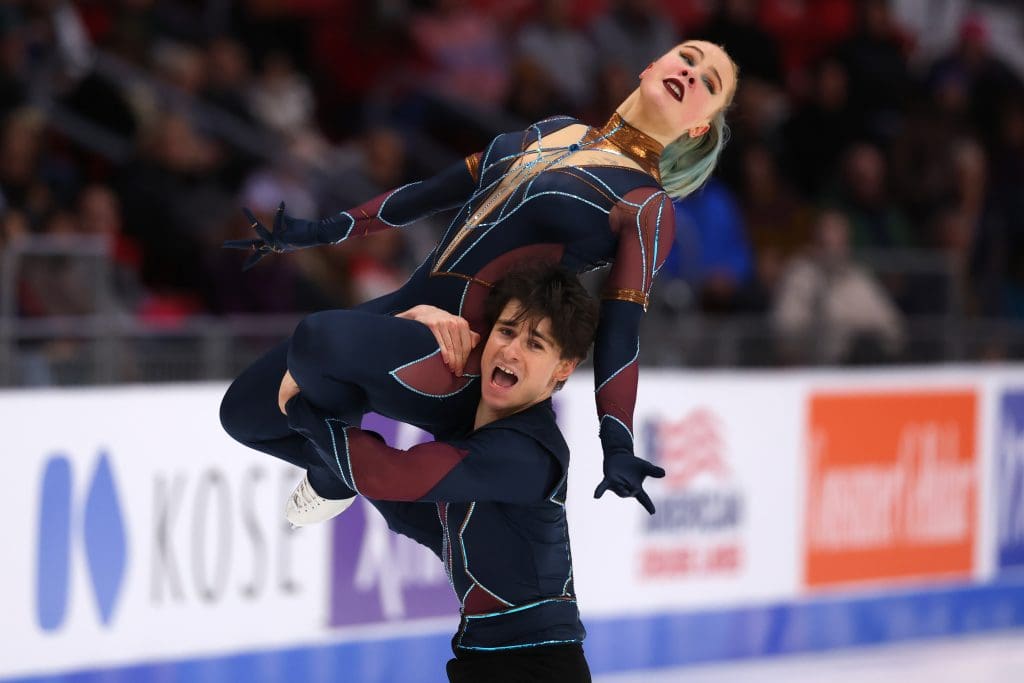
Their free dance, to music from the television series Arcane and the video game League of Legends that the show is based upon, helps them stand apart from the more traditional choices that many teams make in an Olympic year. Arribert explained that this program is, in part, a return to the kind of skating that the team is most comfortable with, after several seasons of pushing their boundaries.
“We worked for three years in a slow way, emotional way, to find connection. When they skated in the beginning, a lot of judges told me that it’s not connected enough and it’s too much dynamic movements. So we said, ‘Okay, we have to change the way we work, we have to improve on this. So, we chose Clair de Lune, we chose slow music, to [develop] skating together and to feel the fluid movement.”
“After these three years, I said, ‘Oh, it’s too much. I want to completely change the style.’ I really like movies, art, and shows, and we talk a lot, with Théo and Loïcia. And we talked about this video game, Arcane. I listened to all the music and I said, ’It will be super cool. When every skater for the Olympic Games is going to choose Carmen, we have a completely different choice.’ And, you know, there is no bad publicity, there is just publicity. When you are [one of] 30 teams, you have to find something new and be different from the other ones…They’re young, and it’s some modern dance, so I think it’s a good choice.”
Fighting for the Olympic stage
In the last two seasons, Demougeot and Le Mercier were solidly the second-best team in France, behind Evgeniia Lopareva and Geoffrey Brissaud. When 2022 Olympic Champion Guillaume Cizeron announced that he would be teaming up with Laurence Fournier-Beaudry and returning to competition, it was a blow to the young French team, who saw their chance at one of France’s two Olympic spots slipping away. Nonetheless, Arribert said that they found motivation in this challenge.
“As you see, they are better than last year. [But] in the beginning, it was so difficult for them…When they learned that Guillaume was coming back, we were in competition. I had to tell them…and in the beginning, they believed that he had to [sit out] one year before he can compete. So they don’t understand, really. They say, ‘But she’s Canadian.’ ‘Yes, but you know…In France, we are not in Switzerland, so it’s possible that she can have a passport. I think that if they are good, they are going to go to the Olympics, and not you.’”
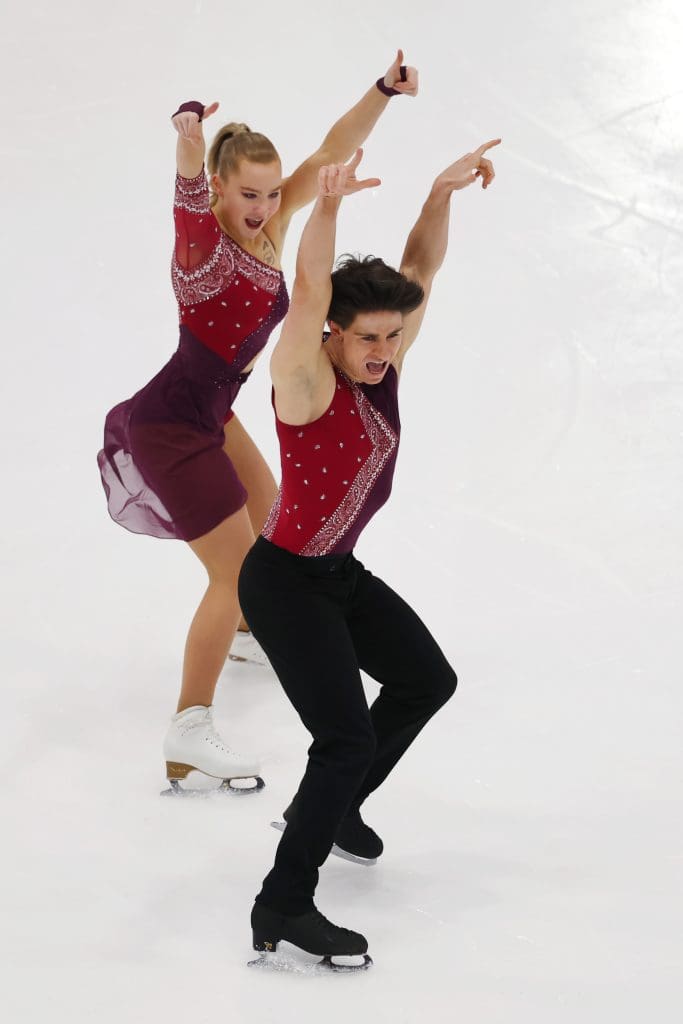
The skaters reacted in different ways. “In the beginning, Loïcia said, ‘It’s hard, but it’s okay….I have to improve by myself, for myself, my own way.’ And Théo, he really [shut down] for two weeks. He wanted to stop skating – but it was just emotional. He came back and said, ‘Okay, okay, we have to improve, and we have to be better.’”
“I explained, ‘We have two spots. You have no choice. You have to be the second one.’ And last year, we were really far away from Lopareva/Brissaud. But this year, we are really close. We will try – but it’s okay. If Lopareva/Brissaud are better, they have to go to the Olympics.”
At Skate America, Demougeot and Le Mercier gained ground on Lopareva/Brissaud, with only one place and less than six points separating their total scores.
As the coach of a small club, does Arribert find it challenging to compete against training centers like the Ice Academy of Montreal, with its dozens of teams from around the world?
“I’m so proud! I’m so proud. We are here. I did a Grand Prix with Théo and Loïcia, and Celina and Jean-Hans, and there are a lot of big coaches [here]. I love them, I love their work, and here, [my skaters are] in the last group…I am a small club, in a small city. I work with my colleague, Mahil Chantelauze, and my coach of dance on the floor, but you know, we are just two coaches…We work a lot, a lot, a lot , but I’m so proud. I didn’t skate at a high level, I’m not like Patrice, so I’m very proud that I work at a high level. I work in a passionate way, I really love my work. I am here for a long time, 20 years, and I learn, and I learn, and I learn. We work a lot, because I love my skaters and I love my club.”
Supporting skaters as individuals
Arribert’s passion for her work also comes through when she speaks about mental health and the role of coach in supporting athletes with all body types. She brought up Natalie Taschlerova’s post on Instagram about her struggles with eating disorder and the impact of judgemental comments about her body.
“It hurts me so much,” Arribert shared. She has seen how comments on the internet have impacted her skaters, and believes the problem of body shaming goes deep into the culture of the sport. She remembers seeing a fan at Skate America in 2022 call Kaitlin Hawayak over to her to say horrible things about her appearance, and she praised Kaitlyn for speaking out.
Arribert has also evolved her views on the topic. In the past, Arribert used to sometimes tell her female skaters that they needed to lose weight. However, she was told by a medical director that those comments would hurt her skaters. “You can’t talk about this with skaters, because after, they believe that you just see that. We are six hours a day with them, and if we talk about this, it becomes a problem. So now I [tell my skaters], ‘You are exactly as you are. My job is, you have to do your lift, your spin, and have your levels be good…and I’m going to train you exactly as you are.’”
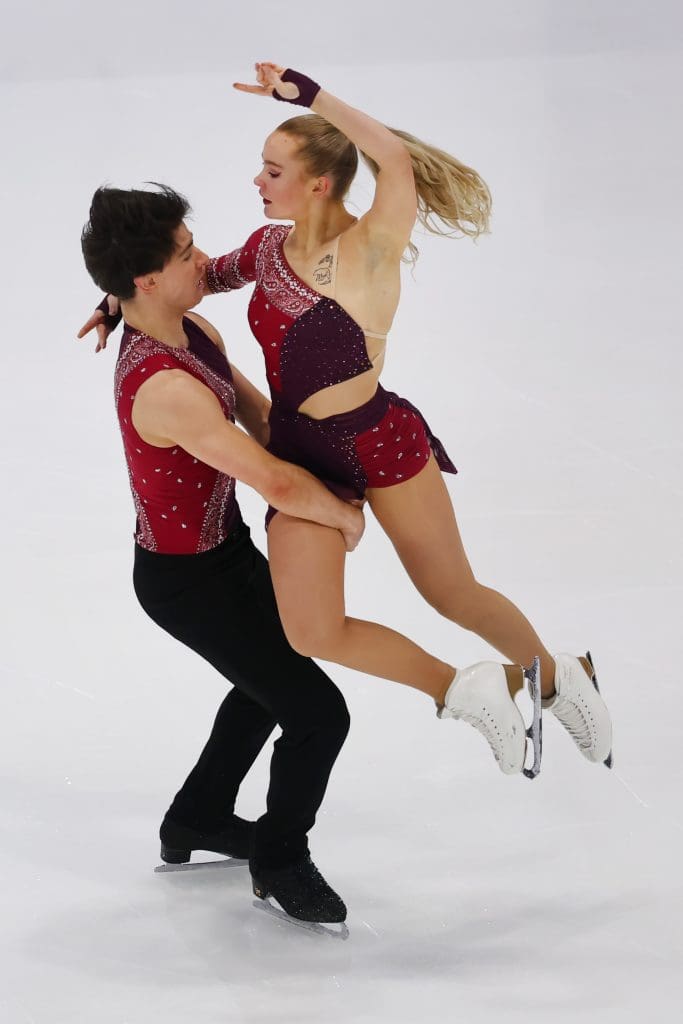
She believes the burden is on the coach to find a way to work with different body types, even though it can be challenging with some elements.
For example, Loïcia and Théo don’t have a big difference in size. “She said to me, ‘Oh, la, la, I have to lose weight,’ and I said, in the summer, ‘Loïcia, you are exactly as you are. I have to be a better coach, to find a solution, with you as you are.’ So we have to find solutions with each body…we chose to do the same lift for two years because this is a beautiful lift, and they are comfortable.”
“Coaches, we are between judges and the Federation and the athletes…Everyone in ice skating has to change. Because a lot of judges said to us, she has to lose weight, a lot of people from the federation said it. [I said], “No, I don’t want to listen to this, just stop. We can talk about… the program, the skating, but I don’t want to understand that you have to lose weight. I disagree.’ But it’s a fight with the judges. I need to fight with the federation.”
She also sees how the demand for perfection impacts skaters mentally.
“When training a child for skating, they can be not-perfect. They can have mistakes. They just have to want to work, and improve, and be athletes, by themselves. They have to choose: ‘I want to be an athlete,’ by themselves. But at the high level, it’s really difficult. They have to be good every time. And after, when they come back to real life, that is why I think it is difficult for them. To not be under the lights, to be a normal person, to have no goal. My daughter skated…and when she stopped she said to me, ‘it’s so difficult [because] each day we have a goal, to be better and better and better…and in real life, we have no goal. We have to find our own goal.’”
She emphasizes the importance of having other things in life beyond skating.
“It is obligatory. If you don’t have this, you can’t come to skate in my school. They have to have something, when the training is not good, they have to come back to the house, and then to have something to get out the bad [mindset]. It’s really a problem. There are a lot of young people that are not with the family. I am a mother, and when my son and my daughter come home after school, we can talk, okay? But when they are alone, if they have no other project, they stay in the black ideas….We are really close to Grenoble, there is a university, and all the high level skaters go to school.”
New directions in Ice Dance
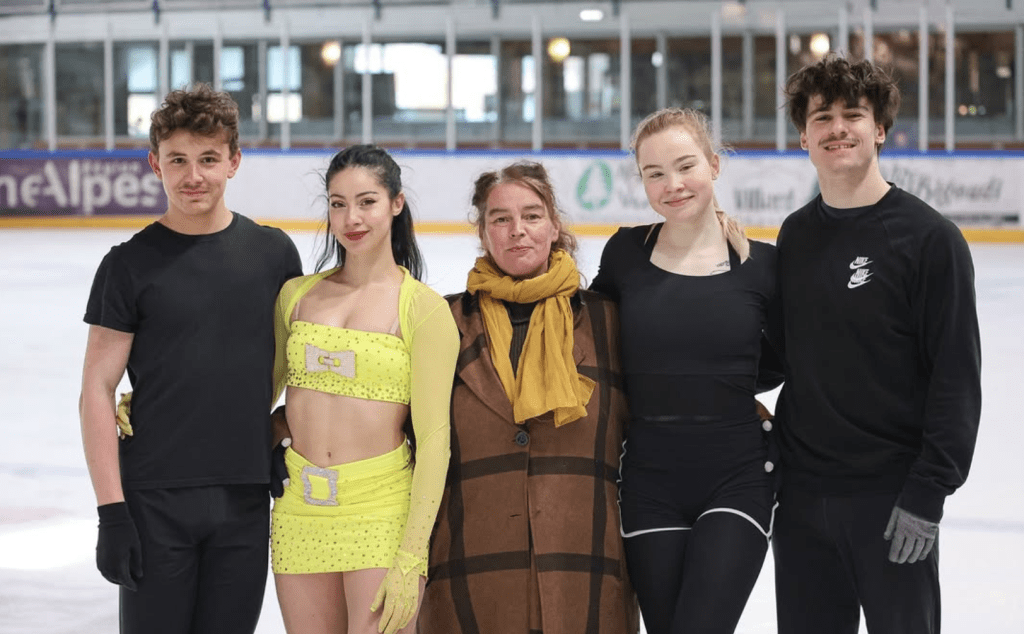
Arribert also weighed in on the debate about the direction ice dance should go in the future. After three years of upbeat, decade-themed rhythm dances, she’d like to see more variety in the next seasons.
“I’m sorry, but we do the same [type of] rhythm dance for a lot of years, and it’s really not interesting, just energy. We [should] change each year to improve. We have to do ballroom, maybe, one year. You have to be good in all styles of dance. It’s what we have to teach to our students….For me, I really enjoy Virtue/Moir. They can dance all [styles]. The reason why I love them is because they can dance modern, contemporary, Latin dance. It’s my way to work…So, I cross my fingers that it changes.”
She’d also like to see judges be willing to reward spectacular elements, even in weaker couples.
“Sometimes skaters in the bottom of the [rankings] do something really beautiful, but they don’t [receive] good GOE. We have to find a way to say, ‘Okay, you are not the best team, but your lift is wonderful, and I give you plus five.’ We have to find a freedom in this way.”
Arribert did not attend the coaches meeting with the Ice Dance Technical Committee that took place at Skate America, but she did get a summary from coach Patrice Lauzon. “He said that they want to change some things a lot, they want to do different competitions…Where I agree with [Technical Committee Chair Shawn Rettstatt] is we can’t have just one medal. We have to have a medal for the short program, and another for the long program. Because they can’t work 6 hours a day for one chance… We have to find something more, if we work four years, for one competition and one medal for all the skaters, it’s not enough.”
Arribert has experience with other competition formats, because she also coaches the Theatre on Ice/Ballet Sur Glace team at Villard de Lans. She sees the team as an important part of her work.
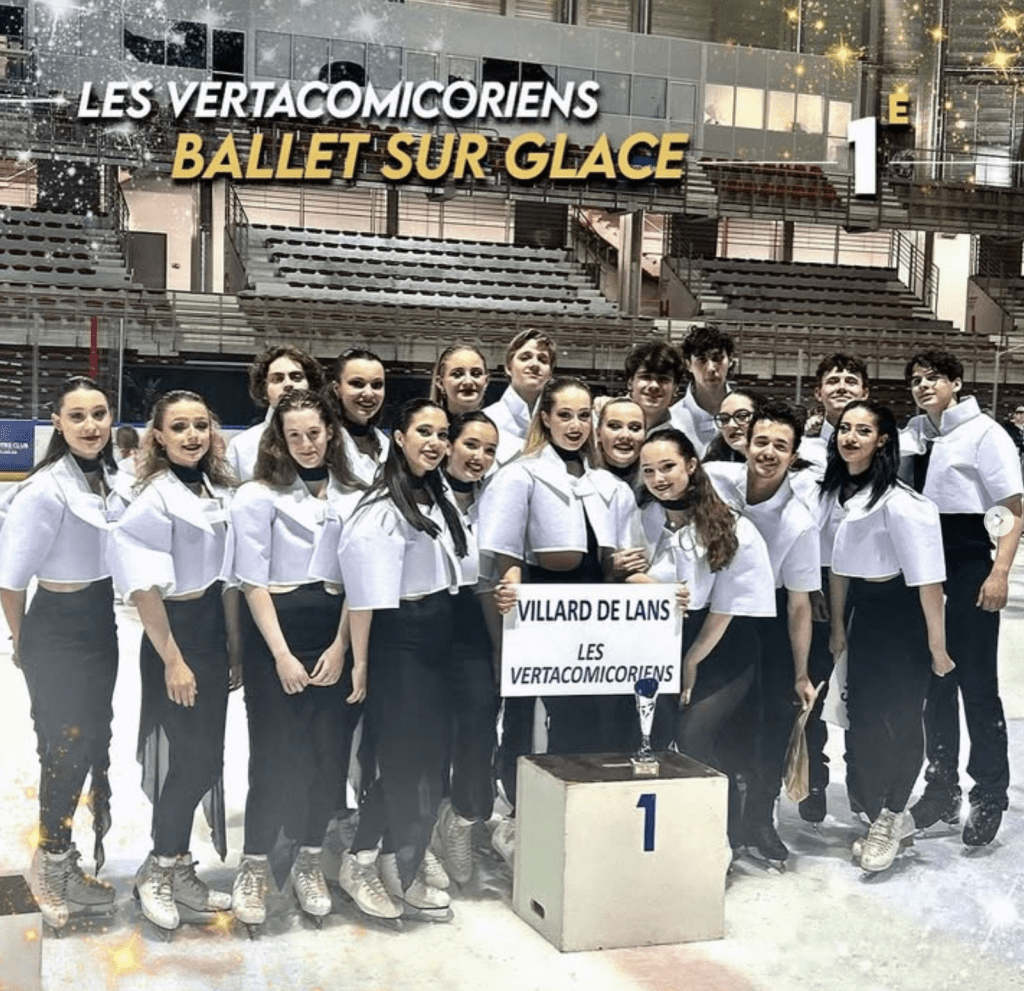
“I work in Villard de Lans. It’s a really small town, and we don’t have a lot of skaters in my club…I have, on one side, a couple of high-level teams, but I have to find something interesting for the other one.”
She was impressed with the Ballet on Ice teams that she saw. “I am also a coach of dance on the floor. So, I said, ‘This is really easy, and we can mix some good skaters and some lower skaters, we can make a team, and it will be interesting to do competition.’…As we are a small, small club, we have to find money. So we do a lot of shows and Ballet. And it keeps an equilibrium between the high-level and the others.”
“But it’s very interesting for my skaters of high level to also skate in the ballet. It’s not the same season. It’s at the end of the year. They finished the big competition, and it’s a moment to enjoy together, to skate. And what is wonderful, [there is] no rhythm, no lift, no one-foot, the free program is five minutes thirty. It’s a long, long one…We are not afraid, ‘oh, my God, attention in choreo step.’ No. It’s absolutely free. And they skate together. So they enjoy this moment.”
Arribert’s work in Ballet sur Glace informs her opinion about potentially allowing duos of any gender combination to compete in ice dance.
“I’m really open,” Arribert shared, “because I am also a coach of dance on the floor, and there is no [sex division]…in France, maybe in five years, they will find a solution to work in duos, two girls or two boys. Like ballet, you know, [we skate] together.””
However, she emphasized that same-sex ice dance should not be considered the same discipline.
“Ice dance is something between the man and the woman. So if we want to change and do dance with the same sex, no problem, but this is not the same discipline, so we have to change the rules. I don’t want to see two persons of the same sex, and one is playing the boy…Have two girls, and be completely free, because if we do two girls, it’s difficult to do a level four lift. [But that’s] okay, I want something new. It will be so interesting…Because in my club, we have a lot of girls who practice alone, and they work together each day. So, they change the place of the boy, of the girl, they do spins together, and like that. And it’s really interesting for them. I have a lot of wonderful girls, they don’t find a partner. And if there is a new discipline, it will be so interesting – but something really different, like the Ballet.”
A to Z with Loïcia Demougeot and Théo le Mercier
Demougeot and Le Mercier Thrive on Their Differences (2024 interview)