



Making sense of the World Standings can be a confusing endeavour.
What competitions count towards the standings? How many points does a skater receive? Why do some points get added to the total and not others? How important are the World Standings to a skater’s season?
These are all questions that have been thrown around when fans try to figure out where their favourite skater will place.
Edit July 2026: The amount of points awarded was modified ahead of the 2026/27 season, this has been reflected in the tables,
ISU Championships and Olympic Winter Games
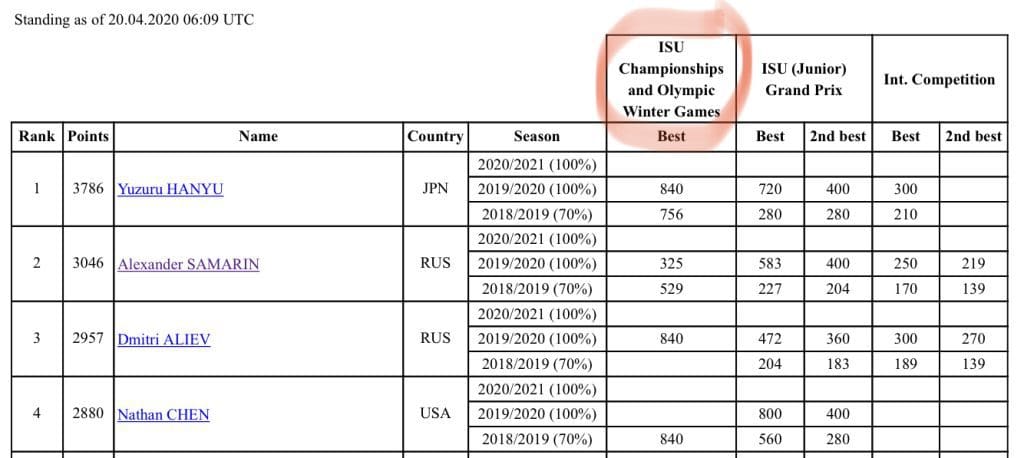
World Standings points are separated into three sections. From the 2023/24 season there is also a Junior-only World Standings list, Junior skaters will still be incorporated into the main World Standings list as well.
ISU Championships/Olympic Winter Games includes: the European Championships, the Four Continents Championships, the World Championships, the Junior World Championships, and the Olympic Winter Games.
Skaters can only receive points for one of these events per season. If they participate in more than one of these events, whichever event they received the highest points for will be included in a skater’s World Standing. Each event takes place annually* except the Olympic Winter Games which happens once every four years.
World Championships / Olympic Winter Games
| Placement | Points |
|---|---|
|
1st |
1300 |
|
2nd |
1150 |
|
3rd |
1020 |
|
4th |
900 |
|
5th |
810 |
|
6th |
740 |
|
7th |
680 |
|
8th |
630 |
|
9th |
580 |
|
10th |
530 |
|
11th |
480 |
|
12th |
430 |
|
13th |
380 |
|
14th |
330 |
|
15th |
290 |
|
16th |
250 |
|
17th |
210 |
|
18th |
180 |
|
19th |
150 |
|
20th |
130 |
|
21st |
120 |
|
22nd |
110 |
|
23rd |
105 |
|
24th |
100 |
European Championships / Four Continents Championships
Whilst it is possible for skaters to participate in both the Olympic Winter Games and World Championships if they have qualified, skaters are unable to attend both the European Championships and the Four Continents Championships as they are region-specific.
| Placement | Points |
|---|---|
|
1st |
850 |
|
2nd |
760 |
|
3rd |
680 |
|
4th |
610 |
|
5th |
550 |
|
6th |
500 |
|
7th |
460 |
|
8th |
420 |
|
9th |
380 |
|
10th |
340 |
|
11th |
300 |
|
12th |
260 |
|
13th |
230 |
|
14th |
200 |
|
15th |
180 |
|
16th |
160 |
|
17th |
140 |
|
18th |
120 |
|
19th |
110 |
|
20th |
100 |
|
21st |
90 |
|
22nd |
80 |
|
23rd |
75 |
|
24th |
70 |
World Junior Championships
In addition to these events, the World Junior Championship also comes under this section. However, the points awarded for this event (and all Junior events) are considerably less than what Senior skaters are awarded.
Skaters and teams, if eligible and chosen to represent their country, can compete at both the Senior World Championships and the Junior World Championships. Although as previously stated, only one of these events, the highest scoring one, will count towards their World Standing.
| Placement | Points |
|---|---|
|
1st |
600 |
|
2nd |
540 |
|
3rd |
490 |
|
4th |
450 |
|
5th |
410 |
|
6th |
370 |
|
7th |
340 |
|
8th |
310 |
|
9th |
280 |
|
10th |
250 |
|
11th |
220 |
|
12th |
190 |
|
13th |
160 |
|
14th |
140 |
|
15th |
120 |
|
16th |
110 |
|
17th |
100 |
|
18th |
90 |
|
19th |
80 |
|
20th |
70 |
|
21st |
65 |
|
22nd |
60 |
|
23rd |
55 |
|
24th |
50 |
ISU Grand Prix and Junior Grand Prix
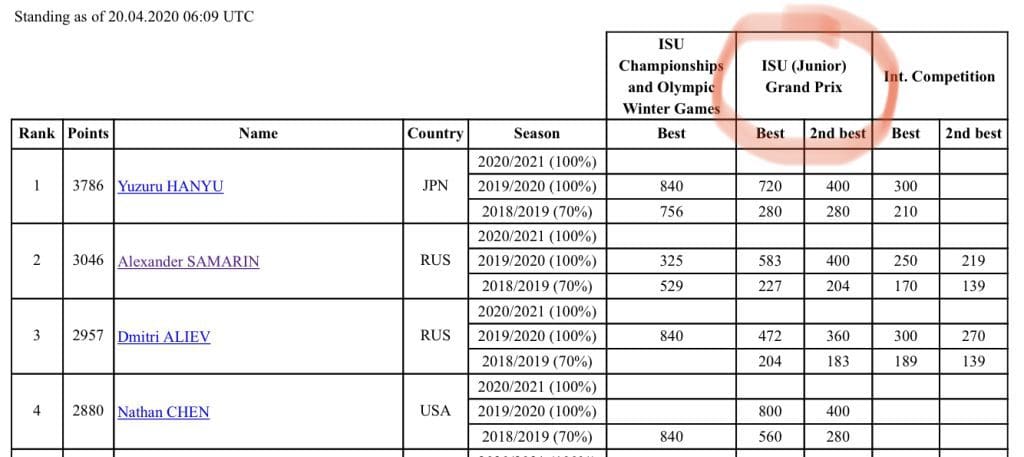
The second section of World Standing points is dedicated to points awarded during the Grand Prix series for Seniors or Junior Grand Prix series for Juniors. Skaters and teams cannot participate in both the Senior and Junior Grand Prix series.
In this section, skaters can earn up to two allocations of points. If they participate and earn a points finish in two Grand Prix events, these points will be added to their World Standing.
ISU Grand Prix
The ISU Grand Prix awards points to the top 8 skaters/teams at an event.
| Placement | Points |
|---|---|
|
1st |
500 |
|
2nd |
450 |
|
3rd |
400 |
|
4th |
360 |
|
5th |
320 |
|
6th |
280 |
|
7th |
240 |
|
8th |
200 |
ISU Junior Grand Prix
The ISU Junior Grand Prix awards points to the top 10 skaters/teams at an event.
| Placement | Points |
|---|---|
|
1st |
300 |
|
2nd |
270 |
|
3rd |
245 |
|
4th |
220 |
|
5th |
200 |
|
6th |
180 |
|
7th |
160 |
|
8th |
140 |
|
9th |
120 |
|
10th |
100 |
ISU Grand Prix Semi-Finals
The ISU Grand Prix Semi-Finals will be incorporated into the skating season from the 2027/28 season onwards. It awards points to the top 6 skaters/teams at an event.
| Placement | Points |
|---|---|
|
1st |
750 |
|
2nd |
670 |
|
3rd |
590 |
|
4th |
510 |
|
5th |
430 |
|
6th |
350 |
ISU Grand Prix Final
If a skater or team qualifies for the Grand Prix Final or Junior Grand Prix Final, the points they earn there may supersede the lowest points they earned at one of their Grand Prix events, as only the two highest results from the series count towards their World Standings.
| Placement | Points |
|---|---|
|
1st |
1000 |
|
2nd |
880 |
|
3rd |
780 |
|
4th |
700 |
|
5th |
640 |
|
6th |
600 |
ISU Junior Grand Prix Final
| Placement | Points |
|---|---|
|
1st |
450 |
|
2nd |
400 |
|
3rd |
360 |
|
4th |
320 |
|
5th |
280 |
|
6th |
250 |
International Competition
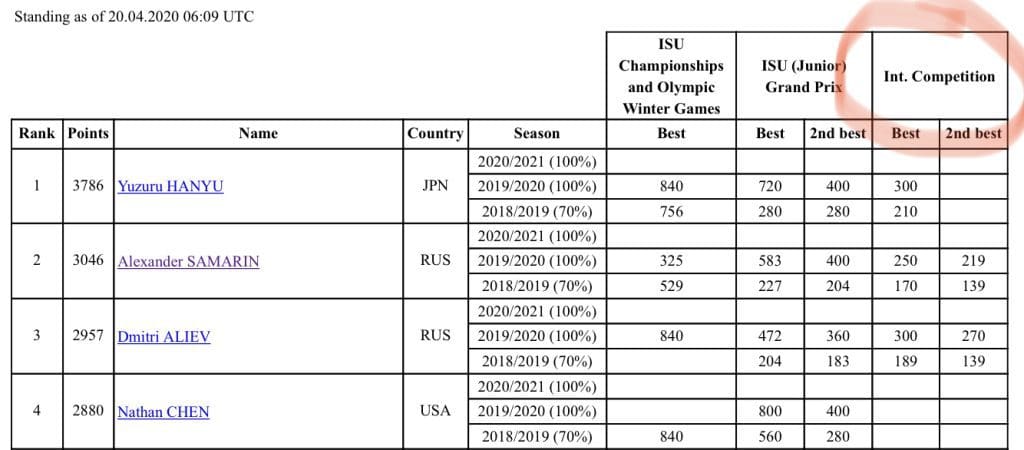
International Competition refers to other competitions that take place throughout the figure skating season and includes the Challenger series and other “B competitions”. These competitions are particularly important in helping lower-ranked skaters in moving up the World Rankings and presenting more opportunities for themselves in the future.
Like the Grand Prix section, skaters and teams can earn points from two of these competitions over the course of the figure skating season. If they take part in more than two competitions that earn them points, only the two highest will be added to the World Standings.
ISU Challenger Series
The Challenger Series takes place over the course of the skating season, with most competitions in the first half of the season. Skaters and teams are permitted to compete in up to three Challenger events, however only their two highest-ranked finishes can count towards their World Standings points. Skaters are permitted to take part in both the Challenger Series and the Grand Prix series as long as the events don’t clash.
Unlike other events in the figure skating season, points vary between Singles, Pairs, and Ice Dance.
| Placement | Singles | Pairs | Ice Dance |
|---|---|---|---|
|
1st |
350 |
350 |
350 |
|
2nd |
310 |
310 |
310 |
|
3rd |
275 |
275 |
275 |
|
4th |
240 |
240 |
240 |
|
5th |
210 |
210 |
210 |
|
6th |
185 |
|
185 |
|
7th |
165 |
|
|
|
8th |
150 |
|
|
Other International Competitions
There are many international competitions in the figure skating calendar over the course of the year. However, not all of these competitions are viable for awarding World Standing points.
A point-awarding international competition must adhere to the following criteria:-
- a minimum of 8 singles skaters from 4 ISU member countries
- a minimum of 6 ice dance teams from 4 ISU member countries
- a minimum of 5 pairs teams, from 3 ISU member countries
- the technical panel must be from 3 different ISU member countries
- Regional competitions
- Competitions that only allow participation from a particular group of skaters (for example, Universiade, which is only open to skaters studying at University)
- Events that work on an invitational basis (excluding the Grand Prix series)
| Placement | Points |
|---|---|
|
1st |
200 |
|
2nd |
150 |
|
3rd |
100 |
Junior International Competitions
From the 2023/24 season other Junior international competitions (not the JGP or Junior Worlds) are now eligible for World Standings points. The same rules apply as with Senior competitions, although points awarded are lower.
| Placement | Points |
|---|---|
|
1st |
100 |
|
2nd |
80 |
|
3rd |
60 |
|
4th |
40 |
|
5th |
20 |
Why do some points count towards the total and not others?
The World Standings include points from the current season, and the two previous seasons. The points from two seasons prior are reduced to 70% of their original worth.
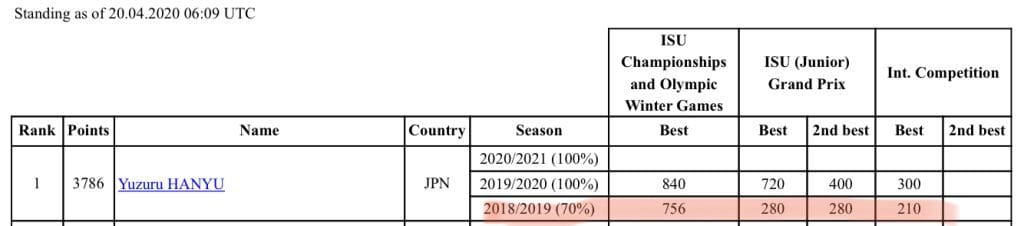
In the ISU Championships and Olympic Winter Games section, only the two highest points earned over the three seasons will be included in the total points.
In the ISU Grand Prix and International Competitions sections, only the top four of six highest points over the three seasons will be included in the total points.

Any points that don’t currently count towards the skater’s/team’s total will have brackets around them. These points can eventually count towards the total when the current season has passed, as the oldest season’s points will be nullified and these points may now become one of the top four highest points achieved by a skater/team.
What effect do the World Standings have on a skater or team's future?
Where a skater or team places in the World Standings is important in regards to which starting group they will be drawn during major ISU events. The higher ranked skaters will usually be drawn for later groups, and the assumption is that the consistently “best” and most competitive skaters and teams in the world will be starting in the final group. The Junior-only World Standings will be used to determine the starting order at Junior Worlds.
The World Standings are also used to assign spots in the Grand Prix series. Every skater or team within the top 24 should be offered one spot at a Grand Prix pending availability. This rule can also benefit skaters who may have missed competitions due to injury or other circumstances, as their scores from prior seasons may be enough to keep them highly ranked.
The World Standings system does, however, reward the skaters and teams who compete the most. Some of the most acclaimed skaters and teams in the world may limit the number of events they participate in to the most important Championships and Grand Prix series, favouring titles over points and to potentially avoid the risk of causing themselves injury.