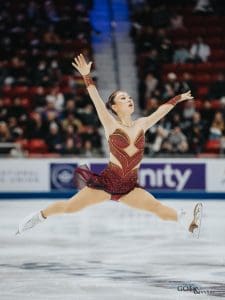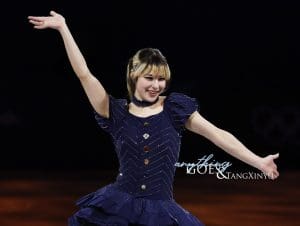
Following a top 10 finish at the 2025 European Championships and after qualifying a quota for Great Britain at the Olympics, Kristen Spours announced that she was taking a break from skating. Between ice sessions, a week after her comeback at the British National Championships, she opened up to AnythingGOEs about the private lows that had accompanied the public highs of a successful season.
Spring 2025
Timing is everything in sports.
For British skater Kristen Spours, the pivotal 2024/25 season was a career best, which included milestones such as her first Senior National title, a top 10 placement at her first European Championships, and, of course, qualifying the Olympic quota for Great Britain.
Yet in spite of how her season went on paper, or through results pages and PDF protocols, Spours was struggling with the weight of the Olympic pressure.
At the 2025 World Championships in Boston, Spours had just qualified an Olympic berth for Great Britain, but knew something wasn’t right within. Reflecting on the period nine months later, she said that she had become “obsessed” with the need to qualify for the Olympics, and was the “most unhappy” she had ever been.
The 24/25 season had been one in which she had had her foot continuously on the accelerator without giving herself a chance to ever apply the brakes. After realising that qualifying an Olympic spot was within reach, she had found herself in a “dark, spirally place.”
“I started [thinking], if I just do this 1% more, I’ll be better. And then 1%, 1%, 1%. And then suddenly I was too far off the other side of it,” she reflected.
I thought there would be this amazing moment where there’d be tears of joy and it would be this everything was worth it moment for me, and I just didn’t have it.
“I qualified the spot in Boston and inevitably wasn’t feeling instantly better and fixed,” she continued. “It was a really weird experience for me because it didn’t bring me happiness. I just qualified a spot and was like, cool. I thought there would be this amazing moment where there’d be tears of joy and it would be this everything was worth it moment for me, and I just didn’t have it. I qualified a spot, shrugged, and cried in my hotel room about it.”
After the World Championships, her job wasn’t done. She also had to fulfil a criteria set by the British Olympic Association to be thought of as ready to send to Milan in February 2026. So she went back to training for two weeks after the competition, before flying to Slovenia to try to achieve her next goal at Triglav Trophy. “By the time I got to Boston, I was just in such a bad place, like an unhealthy place of skating, that going to Slovenia [or] not going to Slovenia didn’t matter to me. My head was just like, must run programs, must run programs, need to perform, need to perform.”
Spours delivered a clean short program, but ended up withdrawing before the free skate. Despite the clear signs that she had pushed herself too far, she went back to training after a week’s break. She recalls thinking that her glute was sore during the practice session, and explained that the combination of “massively overtraining” and “underfuelling in [the] quest to be in shape all the time” had set the stage for a devastating injury.
Two days later, she woke up with pain shooting down her left leg.
The following day the pain was gone, but, she had no power in her leg.
Spring/Summer 2025
Speaking of the injury over Zoom, Spours described the experience as “terrifying.” Yet she highlighted its silver lining: “I think the injury was obviously terrible, but in a weird way, [it was] the best thing to happen to me, because it made me stop.”
The injury abruptly put her career and health into perspective. “Very quickly, I went from being in a position of being like, okay, well, I’ll get an injection for it and I’ll be back for the Olympics to being like, oh my God, will I ever walk without a limp again?”

Following an MRI and consultation with a surgeon, Spours was told that her disc had ruptured and secreted part of its disc matter, causing a neural compression. Spinal injections dealt with the “constant shooting pain” that she was feeling, and she first opted for a conservative approach to recovery, working with TK Physio, a physiotherapist in London, and a team at the Olympic rehab facility.
Nevertheless, this approach failed to produce the desired results. The neural connection to her leg had been lost, and she said during her physio sessions she would stand and have to ask, ‘So how do you walk?’. “People say, can’t you rehab a calf, but you can’t rehab something that doesn’t work,” she explained. “I couldn’t build muscle when there was no contraction. There’s nothing that works in it.”
Spours thus underwent spinal surgery on the 19th of June, which she approached with little apprehension. “I was at a point of just being like, even if I never compete again, for the longevity of my life, this is the right thing to do. Worst case, it basically stays the same or gets a bit better.”
The surgery was successful, and despite it not being an “instant fix,” Spours was walking just one hour after the surgery. She was even on the ice three weeks later, for the first time since her injury.
The psychological effects were also notable. After the injury, she developed severe anxiety, setting alarms every hour of the night to “check it hadn’t gotten worse, because in my head I was just terrified that I would wake up and it would be worse, or the other leg would be dead.” Following the surgery, that acute anxiety eased, and she described feeling “the most relaxed” she had been since the injury.
You’re under this worldly pressure: it’s perfectly normal to struggle.
However, the injury intensified mental-health issues that had already been present throughout the season and extended well beyond the immediate physical trauma. Even though she had had a long collaboration with a sports psychologist, her struggles had gone “wildly beyond sports psychology.”
“I clearly didn’t have a problem performing,” she explained. “I went out and [made] national records, qualified an Olympic spot, [came] top ten in Europe, won my first title.”
The dissonance between her public persona and her private struggles had become more extreme over the season, and she described the strain of constantly having to “put a smile on and perform, [while] in my actual life I was struggling to take a shower.”
Following the World Championships, Spours therefore turned to working with a clinical psychologist, and began to realise that she “had value beyond the Olympics.” He assured her that her experiences and struggles were “quite sane,” underscoring the reality that “you’re under this worldly pressure: it’s perfectly normal to struggle.”
Autumn 2025
On the 6th of September, Spours posted on Instagram that she had decided to take a break from skating, stating that “it is now time to put my overall health above performance.” She added that she hoped that the “Kristen of the future […] will understand no competitive outcome would ever have fulfilled her at the cost it has been coming at both physically and mentally and that she had a future to protect.”
The decision to step away from training in the lead-up to an Olympic season was anything but straightforward. “The Olympics is something that I have dreamed about my entire life, and to be so close to it and to be like, you know what, this is not what I want right now is a really weird thing to come to terms with.”
Yet at the same time, Spours understood the privilege of being able to “walk normally”, and the risk of losing it if she kept going. She recalled speaking to someone about ‘the Olympic dream’, and thinking to herself “what is a dream about this? I feel like I am living an absolute nightmare. This is never what it was meant to be.”
One of her friends then reminded her that she could “just say stop,” and that she could “always change her mind.”
She was met with support from her coaches Christopher Boyadji and Lloyd Jones, the former highlighting that she needed to do “the right thing” for herself “as a person, not as a skater.” The most difficult conversation was with her parents, Spours said. “I’m really aware that they’ve done it with me. They drove me to the rink every day as a kid. We all invested a huge amount in this Olympic dream.”
A key element of her recovery was forming a new approach to skating: one that could not be more different from the mindset with which she had gone into the 2025 World Championships. “If I wanted to skate, I would skate. And if I didn’t want to skate, I wouldn’t skate.”
“It was really baby steps,” she recalled. Midway through October, she began doing double jumps, followed by some triples. “It became a game of testing for me, because even now I get quite a lot of anxiety over the injury. So it became this thing of being like, okay, I’ve done a double, nothing broke. Okay, now I can try a spin, nothing broke. Now I can try this, nothing broke. So it just then kind of ticked along.”
I’ve developed an understanding that my value is beyond a triple flip and a triple loop.
Winter 2025
A mere five weeks before British Nationals, Spours went to her coaches and told them that she wanted to go to the competition. “I wanted to go [to Nationals] to finish the story in my own way,” she said of the decision. “I wanted to fall back in love with something that I had loved so much.”
Her experience of being back on the ice at the competition?
“I loved it,” she said. “I loved being back. I was at a point psychologically where I could have a great moment or not have a great moment, but be okay. Because I’d been in such a life-or-death scenario with skating [before].”

In fact, Spours’ first-place finish was an achievement that she “enjoyed more” than the same win at British Nationals the previous year. “I didn’t skate anywhere near as well as I did last year, but it meant so much more to me. I felt really alive, and felt that spark.”
She was named to the Olympic team two weeks after her comeback.
In January, Spours was back in Sheffield, only this time for the European Championships. Ahead of the competition, she said that she simply didn’t want to “take anything for granted,” adding that “I do still feel a bit like I live on a knife edge: my back is obviously not fixed. I still don’t have a fully functioning left leg. It’s just [about] enjoying the moment and if it’s a great skate, then it’s a great skate. I’ll go [to the European Championships], and I will have worked as hard as I can and there’s nothing I can change about it.”
The event, in front of a home crowd, was in addition a chance to have her family in the audience in her final competitive season. “I’m really grateful to have my family here,” she said in the mixed zone following the short program. “I’m retiring in Prague, so this will be the last time my dad will see me skate, because he can’t travel for health reasons. It’s really special.”

Spours highlighted throughout our conversation that her support system had been key in her road to healing. Her coaching team is “a family” to her: “I feel this unwavering level of support, especially from Lloyd and Chris. I feel like it’s a judgment free zone. They’ve seen me at my absolute lowest and worst and been there, and there was no judgment. They picked up the pieces.”
“I’m a perfectionist in the way that I work and it frustrates me now that there are things that I can’t do because of my left leg. I can’t do a double axel; spins are quite challenging because I can’t spin on a straight leg. I can’t do a camel spin. I can’t do an upright spin. I’m stuck having to figure out different variations. But my team are really, really good at saying, Kristen, calm down, look at where we are, what we’re doing. I think we’re all on a very good, and the same, wavelength of being like, we are here to produce things, but do it in a positive way, have good memories.”
“I think I’ve developed an understanding that my value is beyond a triple flip and a triple loop.”

The 25-year-old, who funds all of her skating and living expenses from the coaching that she does, stressed that “A lot of the athletes that are lower down struggle because we’re the ones that are funding it. We don’t necessarily have that support system; we don’t necessarily have that funding. The pressure that we take on is much greater than sometimes some of the pressure at the top, in a different way.”
Spours said that fellow women’s figure skater Gracie Gold’s book on her own struggles in the sport had been impactful. Yet at the same time, she wanted to underscore the validity and specific importance of her experience as an athlete “at the lower level”: “I’m not Gracie Gold, I’m not an Olympic champion, I’m not Michael Phelps.”
Summarising her journey over the past year, Spours knows that she’s not “fixed,” but has made peace with her journey and her story to tell.
I’ve accepted that this is my story, my journey, and I’m here for the ride of it. It changes you and it changes your perspective on things. I think I’m a different person to who I was before. I wish I hadn’t had to go through it in some ways, but I’m also grateful that I have because it’s changed the way that I view so much and view myself.
So, I’m a work in progress.
Follow Kristen: