



Raimo Reinsalu’s Olympic accreditation revoked
Content Warning: violence, physical and emotional abuse

On Saturday February 7th, the Lithuanian Olympic Committee (LTOK) revoked the accreditation for the Milano Cortina Olympics of Raimo Reinsalu, who is under investigation for allegations of emotional and physical abuse.
The following day, February 8th, the International Skating Union (ISU) confirmed to AnythingGOEs that “[the] ISU Disciplinary Commission has imposed a provisional suspension on Mr. Raimo Reinsalu. The decision has been appealed, and the proceedings are ongoing.”
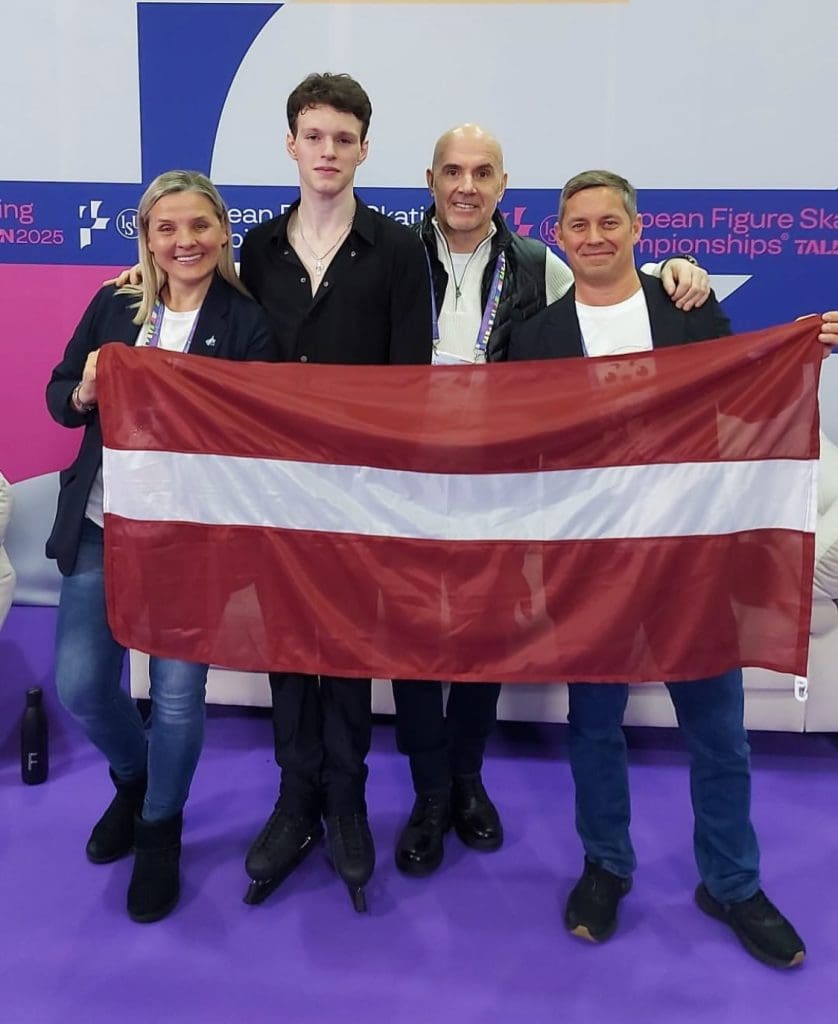
Reinsalu was accredited as a coach of the Lithuanian skater Meda Variakijte, and also had a secondary status with the Latvian Olympic team, as he is part of the coaching team of Fedirs Kuliss, one of Latvia’s two competitors in men’s singles. LTOK shared that Variakijte will be accompanied at the boards by sports director of the Lithuanian Skating Federation, Lilija Vanagienė.
The Latvian site LA.LV published comments from Reinsalu, who called the suspension unfair and biased against his athletes.
AnythingGOEs previously reported that Latvian police opened an investigation into coaches Raimo Reinsalu and Olga Kovalkova for allegations of emotional, and in Reinsalu’s case, physical abuse of minors. In August 2025, the International Skating Union (ISU) confirmed to AnythingGOEs that it was also investigating the allegations against the coaching team.
According to a report in the Lithuanian publication Delfi, the LTOK learned about these investigations shortly before the Olympics. LTOK then consulted with Variakijte, her father, the Latvian Olympic Committee, and with the ISU. While Variakijte and her father had no complaints against Reinsalu, the ISU, on Saturday, February 7th, recommended that he be suspended from the Olympics, and that recommendation was immediately implemented.
A new direction for the ISU?
According the publicly-available proceedings of the ISU Disciplinary Commission, it is rare, if not unprecedented, for a safeguarding case to be brought before the Commission. However, the ISU has recently made clear that it wants to take a greater role in ensuring athlete safety, including with the formation of the Integrity Unit, which will officially assume responsibilities after the ISU Congress in June 2026.
On January 30, the ISU published Communication 2766, which requires federations to notify the ISU of all domestic sanctions. The ISU would then decide whether to issue reciprocal sanctions. “If ISU Members are aware of any imposed sanctions or cases where sanctions may soon be imposed that are relevant to the upcoming Olympic Winter Games 2026, these must be communicated to the ISU as a matter of urgency.”
If Reinsalu’s provisional suspension stands, he will not be able to attend other ISU events such as the Junior or Senior World Championships in March. It is unclear what the timeline is for appealing a provisional suspension. Disciplinary Commission proceedings are published once the final verdict has been reached.
Nearly six months elapsed between Stepcenko’s initial report to the ISU Safeguarding Officer and the issuance of the provisional suspension.
Reinsalu had originally been scheduled to serve as a technical specialist at the September 2025 Junior Grand Prix in Baku but was replaced by another official. At the time, the ISU confirmed that he would not officiate on the Junior Grand Prix circuit.
In January 2026, he appeared as Team Leader for the Latvian delegation at the ISU European Championships in Sheffield. AnythingGOEs contacted both the ISU and the Latvian Skating Association (LSA) to clarify how he was able to receive accreditation for an ISU Championship in that capacity while under investigation.
The LSA did not offer any explanation. The ISU responded that “accreditation can be attributed to individuals in the event that activities have not led to their suspension. The ISU works with all stakeholders to prioritise the safety and well-being of all involved in its competitions and events.”
At this point, Kovalkova has not received any sanction from the Latvian Olympic Committee or the LSA (where she is also a member of the board), and the ISU refused to comment on whether she was a subject of its investigation. LOC has not responded to a request for comment. Kovalkova accompanied Kuliss to official practice on Sunday, and was joined by Slovakian coach Vladimir Dvojnikov.
In August, the LOC told AnythingGOEs “Currently, more comprehensive and detailed Safeguarding procedures within the Latvian Olympic Committee (LOC) are in the process of development and implementation. However, both now and in the past (since 2014), anyone has had the opportunity to contact the Ethics Commission to raise concerns, receive support, and resolve problematic situations. To date, the LOC Ethics Commission has not received any submissions related to figure skating.”
Context of Allegations

In May 2024, Latvian champion Sofja Stepcenko first told officials of the Latvian Skating Association (LSA) about the alleged abuse she experienced during the years she trained with Reinsalu and Kovalkova. In May 2025, she made a formal report to the LSA, and the LSA forwarded the information to the local police.
In July 2025, Stepcenko decided to speak to AnythingGOEs about her allegations. She explained she was frustrated with the lack of action from authorities, and concerned about conflicts of interest within the LSA, where Kovalkova is a member of the board.
Stepcenko told AnythingGOEs that she had been diagnosed with Complex-PTSD connected to the pattern of trauma and abuse she had experienced while training with Kovalkova and Reinsalu. “During [the 2024/2025 season],” said Stepcenko, “I didn’t say anything bad about my former coaches. But now it’s time to say the truth. I basically ran away from my former coaches because they were manipulative… because I was abused [and] they told a lot of gossip and lots of lies about me. They pushed me to do impossible things with injuries…they can promise to get you results, but at what cost? It’s not worth your life.”
She alleges that over years training with Kovalkova and Reinsalu, she was frequently told to skate through injuries, and that injuries were her fault. “I also had a very long-lasting injury since 2021. When I was 14, my left hip started to hurt. I was practicing so much and I told [Reinsalu] I have a pain. He told me to go to the physiotherapist. I went, it didn’t help, and he told me, ‘Why are you lying about this pain, it’s not so much.’”
“The practices were so horrible, so hard. In one of the ice sessions, I felt so dizzy, I saw black, and I was unable to see. And I needed to jump. And I jumped, and I twisted my ankle. Only after three months, I did the MRI, and they found a stress fracture in the hip. I had three months of having this stress fracture and skating. And of course, you should take a break before going back on the ice, like maybe a few months. After one month, I started to jump and I started to have the pain again, and they didn’t believe me. They were telling me, ‘You don’t have the pain. The pain is in your brain.’ Really the main slogan was, ‘the pain is in your brain.’ And you start to believe in that.”
“From August until December [2021], I was really thinking I was crazy. My first two junior Grand Prix events, I was competing with a stress fracture, and then in December, I decided to go to the doctor, and they told me, ‘You have a stress fracture with necrosis inside of your bone, and half of your hamstrings are broken. If you want to be disabled, you can continue to skate. But if you don’t want that, please stop.’ And my coach told me, ‘It was because you had one and a half kilos of extra weight.’”
Several other former students of Kovalkova and Reinsalu have also raised similar allegations, including claims that Reinsalu used physical violence during training, such as grabbing skaters around the neck and hitting athletes with hard plastic skate guards when they made a mistake.
Kovalkova and Reinsalu have denied any wrongdoing.
A request for further information from Stepcenko was issued in September 2025 by the Administrative Violations Investigation Department of the Riga Regional Office Public Order Police Bureau of the State Police. Stepcenko responded in October with detailed documentation, including the names of other athletes that she said could support parts of her testimony, recordings of conversations with Reinsalu and Kovalkova, and copies of text messages.
By December, Stepcenko had received confirmation that the police had opened an investigation, which is ongoing.
Read Part One: “Its Not Worth Your Life”: Latvian Skaters Speak Out About Abuse
Read Part Two: New Allegations Emerge as Latvian Club Defends Coaches Accused of Abuse
Read Part Three: Skaters Criticise Latvian Federation’s Late and Inconsistent Funding
Read Part Four: Latvian Police Investigating Abuse by Coaches