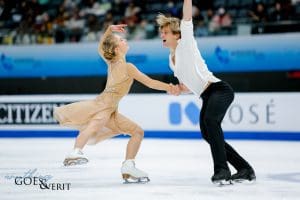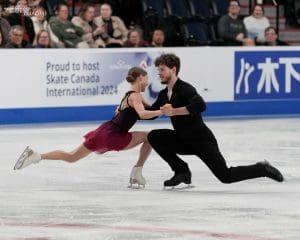



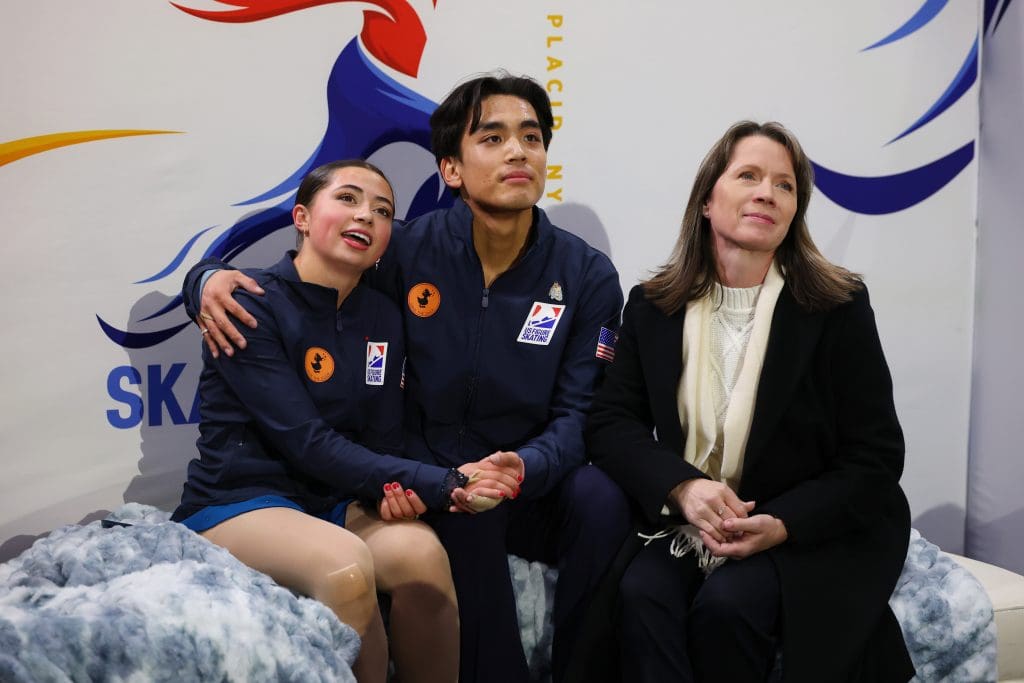
Not long after his short program at the World Junior Championships, American pairs skater Luke Wang took to social media. Not to tweet about his and partner Olivia Flores’ performance, which had them in 4th place, but to share a moment from the warm-up: “When the announcer says ‘Their coach, Natalia Mishkutenok, is the 1992 Olympic Champion and 1994 Olympic silver medalist’– I GOT CHILLS. I get to work with her!”
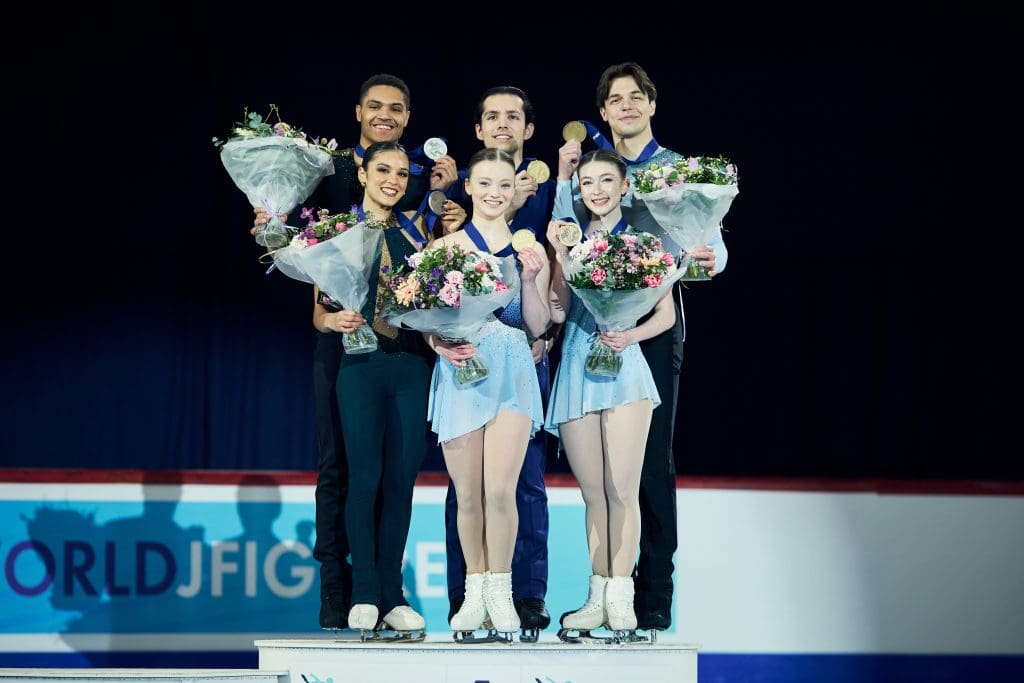
Mishkutenok competed for the Soviet Union, and then Russia, but moved to the United States after she retired. She coached in Dallas for many years before moving to Colorado Springs in 2020, where she now works with pairs at the Broadmoor World Arena along with Drew Meekins. She was a quiet, strong presence at the boards at Junior Worlds in Tallinn, supporting Flores and Wang along with the event’s surprise bronze medalists, Hannah Herrera and Ivan Khobta of Ukraine.
Before the free skate, she spoke to AnythingGOEs about her teams and the future direction of the pairs discipline.
Flores and Wang navigate challenges
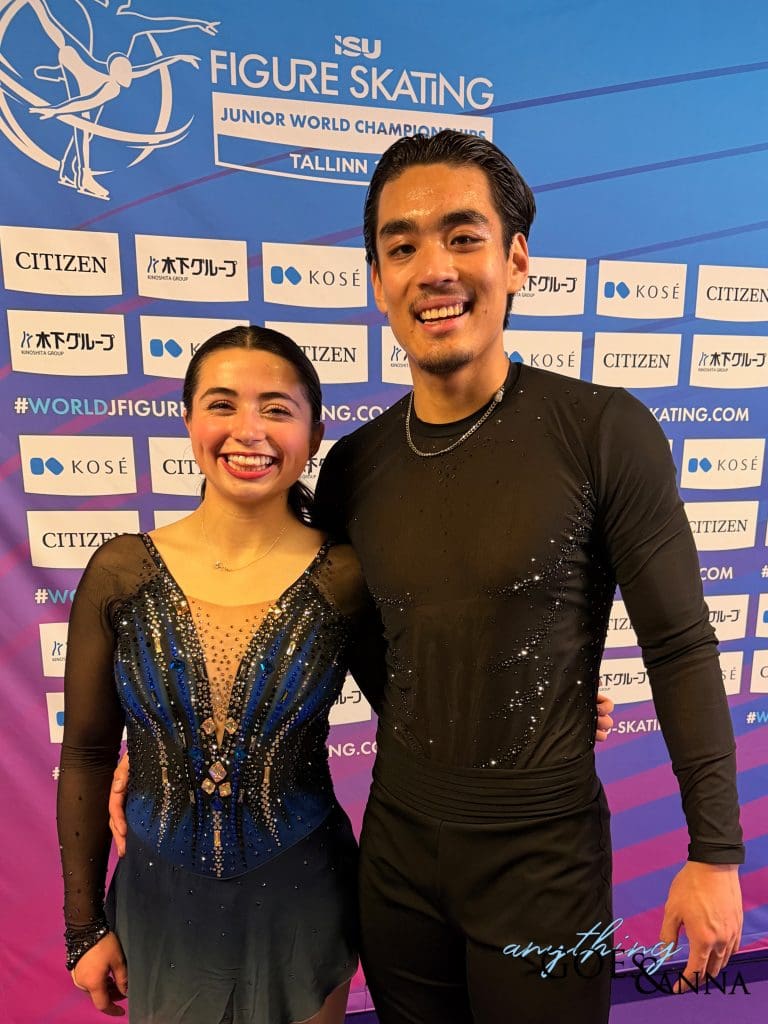
Flores and Wang were the 2024 Junior World silver medalists, but have struggled to reach the top of podiums in the last several years. This season they largely spent in the senior ranks, competing at their first senior Grand Prix at Skate America, and placing 7th in senior at the U.S. Nationals in January.
“This year was challenging for them,” explained Mishkutenok, because “to get to senior [they need] three lifts. They’re not really there yet, so we’re working on that.”
Going back to Junior Worlds meant another experience at an ISU Championship, but also required making big changes to the short program.
“It’s a different jump, a different throw,” said Mishkutenok. “They didn’t practice this throw [flip] for like, a year. So for the last two weeks, we were really trying to get the triple back to normal, but then Olivia got sick the week before we came. So we had to leave it as a double…There’s a lot of little things going on, so we thought, ‘Okay, the throw can suffer, and then we can just focus on everything else.’”
Strong components scores put Flores and Wang into 4th place after the short program. In fact, several judges marked them first in PCS. Unfortunately, an error-ridden Free Skate put them sixth for that segment, and fifth over all.
What is next for this team’s development?
“We decided that after this competition, we will sit down and talk about the future,” said Mishkutenok. “So right now, we aren’t going there yet.”
A medal for Ukraine
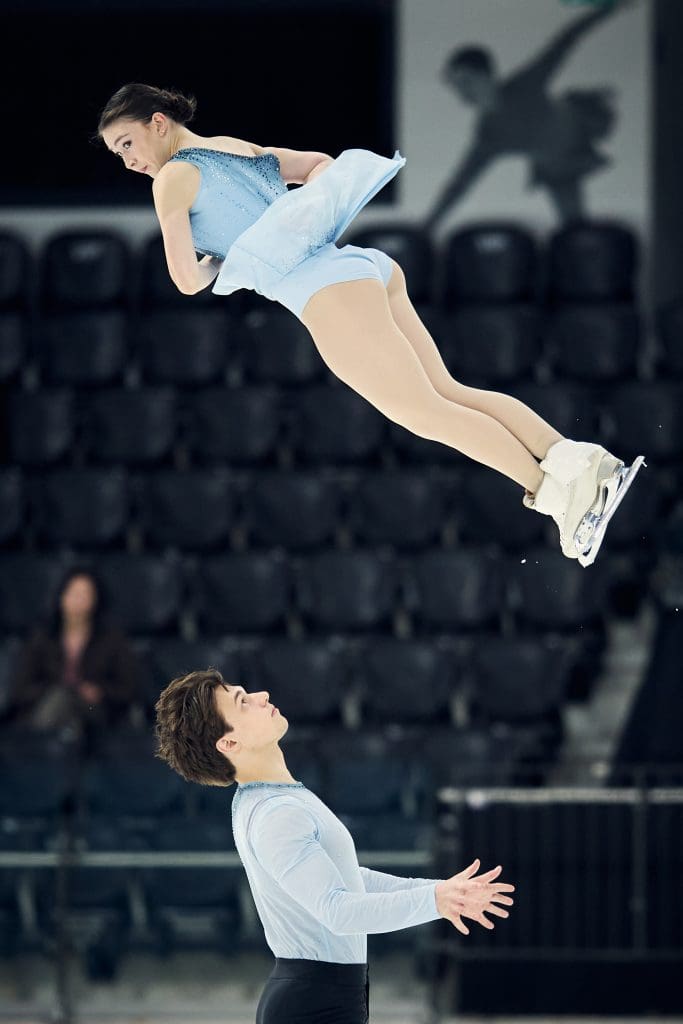
Coming into Junior Worlds, Hannah Herrera and Ivan Khobta were not one of the teams expected to make the podium. It was only the team’s fourth competition together – and Herrera’s fourth-ever pairs competition.
Khobta, however, had some experience to draw on. With former partner Violetta Sierova, he won the bronze medal at Junior Worlds in 2024 and also placed 9th at Europeans that year. But after Sierova retired, Khobta spent a year away from competition.
Mishkutenok helped to put Herrera and Khobta together. “Hannah was a really good single skater, and then she kind of didn’t have a good season. So Ivan was looking for a partner, he had some tryouts, and then she came to try out, and she had zero experience. But she’s the best student. [In] lessons, she is really quiet, shy, and then does everything. She is a really hard-working girl.”
Mishkutenok also noted that starting with no experience can actually help a new pair skater. “She started doing the correct technique. What [Khobta] knew, and what I believe in… it’s easy to work with something like that. A lot of teams have different techniques, [and] it works for them. You can still adjust. But I was taught this way. Since she didn’t know anything about it, it was so much easier to teach her what he knows and what I know.”
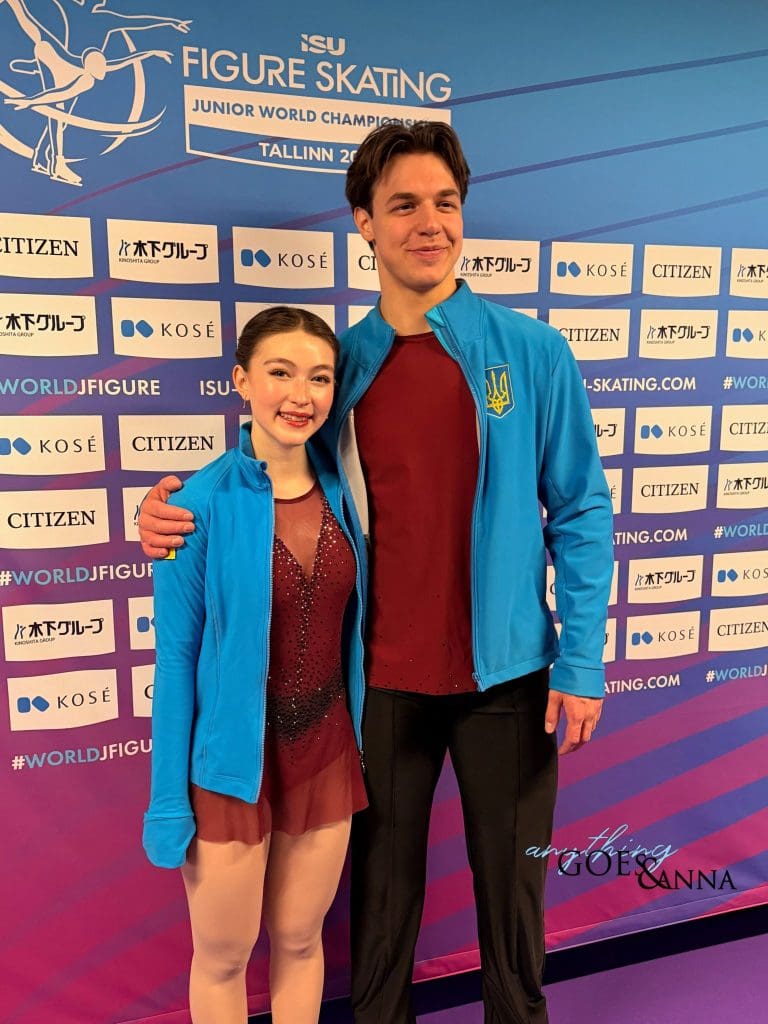
“When the girl knows, and the boy doesn’t, it’s much harder, because he’s the base. If he doesn’t know a lot of stuff, it takes longer. If the boy knows something, and she doesn’t, then it’s easier, because he already has technique, and he can teach her.”
Asked what she likes best about pairs, Herrera cited the twist. Mishkutenok shared that that element “took a long time, because it was a lot of basic work for them, and for her. It was really gradual, and then, by the time they got to triple, they did a lot of just exercises.”
They also continue to work with Khobta’s long-time Ukrainian coach, Pylyp Zalevskyi. “They would train in the US with Drew Meekins, me, and we have other coaches helping us. And then with Pylyp, we have a little group chat, so we send the videos, and then he was watching it. After we went to the Bavarian Open [in January], Ivan and Hannah stayed in Germany with Pylyp. So now Pylyp was sending us videos, and we were working together – but they stayed with Pylyp, and he was in charge of them between the competitions.”
It can be challenging for a new partnership to mesh, but Mishkutenok thinks this team is developing well despite their different backgrounds.
“Ivan speaks Russian, and Pylyp speaks Russian, so sometimes they forget that Hannah does not understand Russian. So, they talk, and if I’m there, I usually translate and say, ‘Guys, don’t forget Hannah.’ And she’s sitting there, quietly.”
“But everything else, I think, works pretty good…it’s only the fourth competition for them, so…they’re going to know more and more how to skate with each other in the competitions, because he reacts differently, and she reacts differently. But it’s just experience.”
Growing a Strong Pairs Program
In Colorado Springs, Mishkutenok and Meekins work closely together to support all their teams. “We try to spread it out so everybody gets a lesson, [even when] someone goes to a competition…it’s nice working together.”
They also take advantage of the many high level coaches at the World Arena. “Our teams work with these singles coaches. Liv and Luke work with Eddie Shipstead, and for example, Hannah and Ivan, they work with Sandy [Straub]…We have a lot of help this way. Even Tammy [Gambil], she was working with Milada [Kovar], you know? So it’s like everybody picks whatever they like.”
Mishkutenok is also grateful to have dedicated ice time for pairs in Colorado, which she cites as one of the biggest barriers to growing the pair discipline.
“In Dallas, I worked there for 20 years…and the challenging thing for the teams was, we didn’t have ice for pair teams. It was mixed. So you go on the ice, and a little kid is skating with a junior, senior pair team, and it’s really tough. That’s why a lot of places don’t have a pair skating program if they don’t get, special ice. And a lot of rinks don’t allow it, because money-wise, they just look at the numbers.”
Mishkutenok encourages skaters who might be interested in pairs to focus on building strong singles skills first.
“People come together when they’re already senior level, and that works. I mean, I started pairs when I was 16. I think later is okay, if you have good skating skills and good jumps. When you’re young, and you’re still working to learn the jumps, you need to skate more, and you need to dedicate a lot of [time] to singles.”
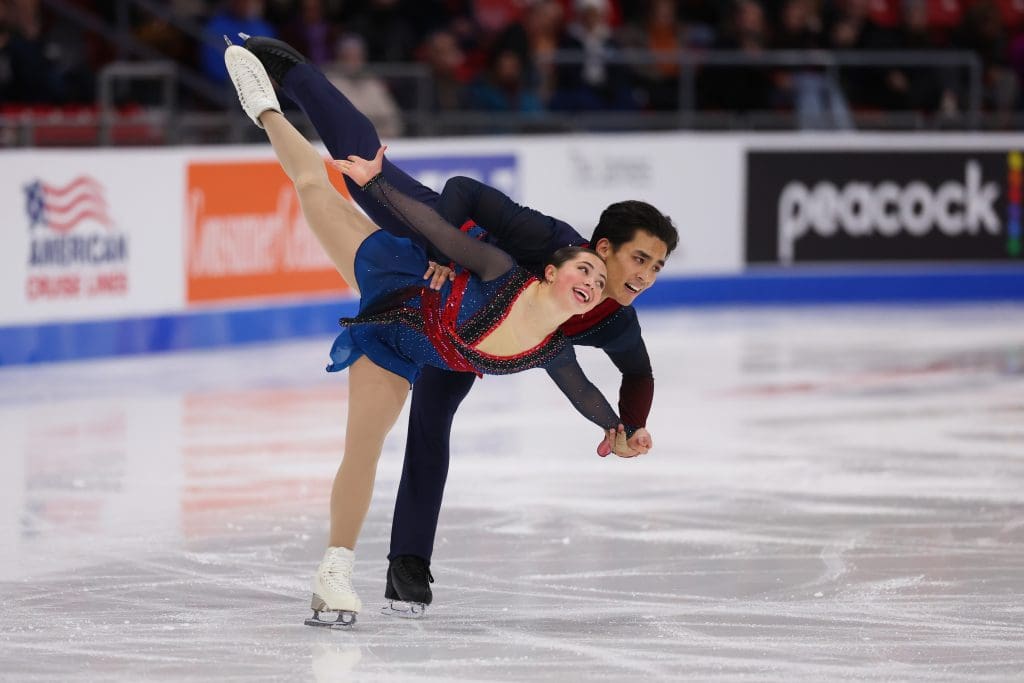
She also keeps an eye out for skaters who have the right personality to enjoy pairs.
“I think a lot of girls, [they want to do pairs because] they like throws and lifts. I have a little girl that moved from Arizona. She was going to ice dance, and she was doing singles. And actually, Ivan was one of her coaches…He was teaching her lifts, and so she’s really excited now to start doing pairs, just because she thinks it’s fun.”
It isn’t a good fit for everyone. “Some girls, though, are like ‘I’m afraid of heights.’ I’m like, ‘that’s not a height! Do you want to try it?’ ‘Oh, no, no. I’m afraid of heights.’ I’m like, ‘Whoa. So weird!’ But I think you have to have some trust or fearlessness or something, in the personality to want to do it. I wanted to do it because I thought it was fun to be thrown and lifted. If you’re not that person, you’re not going to make it.”
Next season, the pairs discipline will introduce the new elements of a choreographic lift and choreographic spin in the Free Skate. Mishkutenok is cautiously positive about these changes.
“I think [the ISU] are trying to make figure skating maybe more exciting again. They try not to restrict people, in some places, because with all these levels and everything, you get restricted to doing [only a few] different things…I think it might be a good idea.”
“When we skated,” she added, “we did a lot of illegal stuff, stuff that right now would be illegal. We didn’t have to do so many changes in the lift to get [the] levels. You know, you just do a lift, [and] that’s a lift. Footwork, they didn’t have to do these clusters and stuff, but just footwork, right? We could fill out the program with everything else that people enjoy watching. I think that’s what they’re trying to [return to], to make it a little bit more fun for people to watch, you know?”
“But I’m happy they only changed the lift and the spin, because they were talking about taking the jump out, and maybe taking the throw out. Then it’s not a competition. It’s more like an exhibition. It should still be competitive.”
More articles in “The Future of Pairs” series:
Part I: Is There a Problem with Pairs?
Part II: Motivation and Building Pair Programs